As Eid al-Adha approaches, one of the pillars of Islam that is performed is the Hajj pilgrimage. In conducting the Hajj, there are specific procedures that must be followed by the pilgrims, known as the pillars of Hajj.
What are the essential pillars of Hajj that must be followed? What are the benefits of performing Hajj? What is the ruling on performing Hajj? Find out more in this article by BFI Finance.
1. About Hajj
1.1 Definition of Hajj
Hajj is the fifth pillar of Islam and is obligatory for every Muslim who is physically, financially, and securely able to perform it, at least once in their lifetime. Hajj is performed in the holy city of Mecca during the month of Dhu al-Hijjah, the last month of the Islamic calendar. During Hajj, pilgrims perform various prescribed rituals that reflect the faith and history of Prophet Ibrahim (Abraham) and his family.
1.2 The Ruling on Performing Hajj
Hajj is obligatory for those who can perform it. This obligation is based on Allah’s command in the Quran, which states:
"In it are clear signs [such as] the standing place of Abraham. And whoever enters it shall be safe. And [due] to Allah from the people is a pilgrimage to the House - for whoever is able to find thereto a way. But whoever disbelieves - then indeed, Allah is free from need of the worlds." (Quran, Al-Imran [3]: 97)
Additionally, the Prophet Muhammad (peace be upon him) emphasized the importance of performing Hajj in his hadith. Abu Hurairah (may Allah be pleased with him) narrated that the Prophet (peace be upon him) said:
"O people, Allah has made Hajj obligatory upon you; so perform Hajj." A man asked, "Is it every year, O Messenger of Allah?" The Prophet (peace be upon him) remained silent until the man repeated his question three times. Then the Prophet (peace be upon him) said, "If I had said yes, it would have become obligatory (every year) and you would not have been able to do it." Then he added, "Leave me with what I have left you. Indeed, those before you were destroyed because they asked too many questions and differed with their prophets. If I command you to do something, do it to the best of your ability. If I forbid you from something, then avoid it."
This hadith indicates that performing Hajj is only obligatory once in a lifetime. Any additional performance of Hajj is considered voluntary.
2. Types of Hajj
There are three types of Hajj that pilgrims can choose from, each with different methods and procedures.
2.1 Hajj Al-Ifrad
Hajj Al-Ifrad is performed separately from Umrah. Pilgrims choosing this type perform the rituals of Hajj without performing Umrah. They enter the state of ihram at the miqat, complete all the rituals of Hajj, and then do tahallul (exit from ihram) without performing Umrah.
2.2 Hajj Al-Qiran
Hajj Al-Qiran involves performing both Hajj and Umrah together. Pilgrims start ihram for both Hajj and Umrah from the same miqat and perform the rituals for both without separating the time of their performance. They do a single Tawaf and Sa’i for both Hajj and Umrah.
2.3 Hajj Al-Tamattu'
Hajj Al-Tamattu' is the most commonly performed type of Hajj. Pilgrims perform Umrah first during the months of Hajj (Shawwal, Dhu al-Qi’dah, and Dhu al-Hijjah), then do tahallul after completing Umrah. On the 8th of Dhu al-Hijjah, they re-enter ihram for Hajj.
3. Pillars of Hajj
3.1 Intention (Niat)
The first pillar of Hajj is having the intention. This is based on the Quranic verse:
"And they were not commanded except to worship Allah, [being] sincere to Him in religion, inclining to truth..." (Quran, Al-Bayyina [98]: 5)
This is also supported by the Prophet Muhammad's (peace be upon him) saying:
"Actions are according to intentions." (Hadith by Bukhari & Muslim)
3.2 Standing at Arafah (Wukuf)
Standing at Arafah is the pinnacle of Hajj. It occurs on the 9th of Dhu al-Hijjah, from noon until sunset. This is confirmed by the hadith narrated by At-Tirmidhi:
“I came to the Prophet (peace be upon him) at Muzdalifah when he was going out for prayer. I asked, ‘O Messenger of Allah, I have come from the two mountains of Tayya, and my mount is exhausted, and I am exhausted too. By Allah, I have not left any mountain in Mecca but I stopped there. Have I performed Hajj?’ The Prophet (peace be upon him) replied: ‘Whoever joins us in our prayer and stays with us until we depart, and he has stood at Arafah before that, whether at night or during the day, his Hajj is complete and he has completed the rituals.’” (Hadith by At-Tirmidhi)
Standing at Arafah is a significant moment where pilgrims pray, remember Allah, and seek forgiveness.
3.3 Tawaf Al-Ifadah

Image Source: Freepik
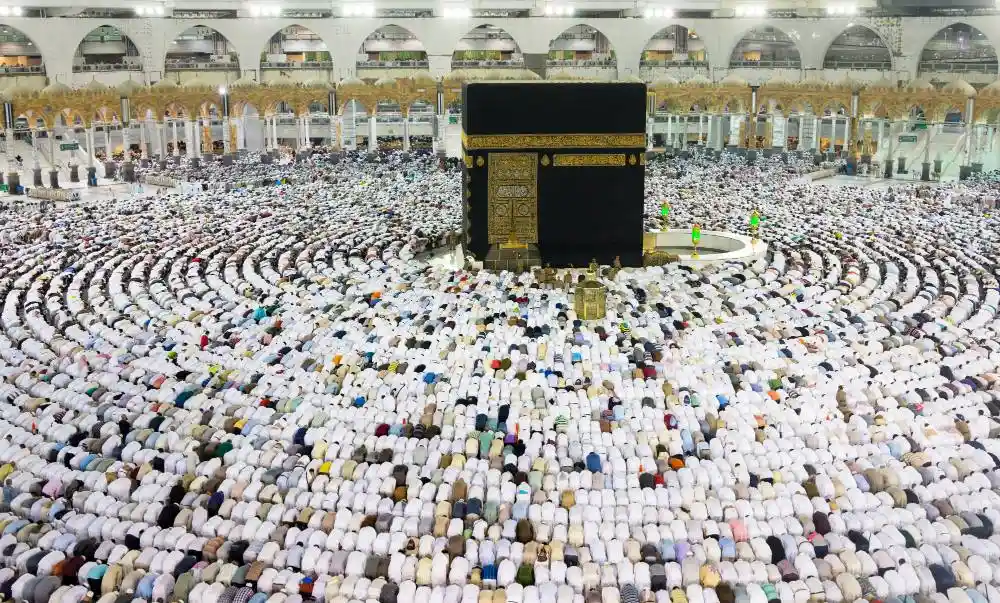
Tawaf is the ritual of circling the Ka’bah seven times counter-clockwise. It is performed at various stages of Hajj, one of which is Tawaf Al-Ifadah after standing at Arafah. Tawaf symbolizes submission and obedience to Allah. Pilgrims may kiss or touch the Black Stone (Hajar Aswad) during Tawaf, but if it is too crowded, they simply point to it.
The obligation of Tawaf is based on the Quranic verse:
"...and circumambulate the ancient House." (Quran, Al-Hajj [22]: 29)
There are specific conditions for Tawaf to be valid:
- Purity from minor and major impurities.
- Covering the awrah (intimate parts) for both men and women.
- Performing seven complete circuits.
- Starting and ending at the Black Stone.
- Performing Tawaf outside the Ka’bah.
- Continuity without significant breaks.
3.4 Sa’i between Safa and Marwah
Sa’i involves walking or running between the hills of Safa and Marwah seven times. It is performed after Tawaf Al-Ifadah. Sa’i replicates Hagar’s (Hajar) search for water for her son Ismail.
Conditions for Sa’i include starting from Safa, ending at Marwah, performing it seven times, and doing it at the Mas’a (the path connecting Safa and Marwah).
3.5 Shaving or Trimming Hair (Tahallul)
Tahallul involves shaving or trimming the hair for men and trimming at least three strands for women. Many men choose to shave their heads completely. This act is mentioned in the Quran:
“...having shaved their heads and [having cut] their hair...” (Quran, Al-Fath [48]: 27)
3.6 Order (Tartib)
The rituals of Hajj must be performed in the correct order. This is based on the Prophet’s (peace be upon him) saying:
"Take from me your rituals." (Hadith by Muslim, An-Nasai, and Ahmad)
The pillars of Hajj must be performed in sequence. Omitting or substituting any part with a penalty or money invalidates the Hajj.
4. Conditions for the Obligation of Hajj
There are specific conditions that must be met for Hajj to be obligatory for a Muslim:
4.1 Being Muslim
Hajj is obligatory only for Muslims. One must believe and practice Islam to perform Hajj. This is based on the Quranic verse:
"Indeed the polytheists are unclean, so let them not approach Al-Masjid Al-Haram after this, their [final] year." (Quran, At-Tawbah [9]: 28)
4.2 Being of Sound Mind
Hajj is obligatory for those who are of sound mind and not in a state of mental illness. This requirement is based on a hadith narrated by Abu Dawud:
"The Pen is lifted from three: the sleeper until he awakens, the child until he reaches puberty, and the insane until he regains sanity." (Hadith by Abu Dawud)
4.3 Being Free
Hajj is obligatory for free individuals and not for slaves. Slaves may perform Hajj, but it does not count as the obligatory Hajj. This is supported by the Prophet’s (peace be upon him) saying:
"If a slave performs Hajj and is later freed, it is obligatory for him to perform another Hajj." (Hadith by Ibn Khuzaimah)
4.4 Reaching Puberty
Hajj is obligatory for those who have reached puberty. However, if a child performs Hajj, it is valid but does not count as the obligatory Hajj. This is based on a hadith narrated by Ibn Abbas:
"A woman lifted her child and said: 'O Messenger of Allah, is there Hajj for this one?' He said: 'Yes, and you will have a reward.'" (Hadith by Muslim)
4.5 Financial and Physical Ability
Hajj is obligatory for those who have the financial and physical means to perform it. This includes having sufficient funds for travel, accommodation, and family support during the pilgrimage. This is based on the Quranic verse:
"And [due] to Allah from the people is a pilgrimage to the House - for whoever is able to find a way." (Quran, Al-Imran [3]: 97)
4.6 Security
Hajj is obligatory for those who can perform it safely. If the pilgrimage poses a danger to one’s life or property, it is not obligatory. This is supported by a hadith narrated by Ibn Abbas:
"When the Prophet (peace be upon him) was prevented from entering Mecca, he performed Hajj the following year." (Hadith by Al-Bukhari)
5. The Virtues of Hajj
Performing Hajj has numerous virtues and significant benefits in the life of a Muslim.
5.1 Forgiveness and Purification of Sins
One of the greatest virtues of Hajj is the forgiveness of sins. The Prophet Muhammad (peace be upon him) said:
"Whoever performs Hajj for the sake of Allah and does not engage in obscene or immoral behavior will return (free of sin) as the day his mother bore him." (Hadith by Bukhari & Muslim)
This hadith emphasizes the importance of maintaining purity of heart and actions during the Hajj pilgrimage, and it illustrates the virtues and forgiveness that Allah grants to those who perform Hajj sincerely and with purity.
5.2 Strengthening Faith
The pilgrimage strengthens faith and devotion to Allah. Through various rituals of Hajj, a Muslim recalls the history and sacrifices of the prophets, and renews their commitment to faith.
5.3 Paradise (Jannah)
A Hajj that is accepted by Allah, known as Hajj Mabrur, is promised Paradise. The Prophet Muhammad (peace be upon him) said:
"An accepted Hajj has no reward except Paradise." (Hadith by Bukhari & Muslim)
This hadith highlights the immense value and virtue of a sincerely performed Hajj. An accepted Hajj by Allah will be the key for a person to gain Paradise as a reward for their devotion and dedication in performing the pilgrimage.
5.4 Becoming a Guest of Allah
Those who perform Hajj are considered guests of Allah. The Quran mentions that Allah invites His chosen servants to come to the House of Allah.
5.5 Blessed Prayers (Doa Mabrur)
Prayers offered during the Hajj pilgrimage have great virtue and a high likelihood of being accepted by Allah. Pilgrims are encouraged to pray abundantly during Hajj.
5.6 Intercession for Family
A Hajj that is accepted can provide intercession for one's family and close ones. The blessings of Hajj are not only felt by the pilgrim but can also be experienced by their family and those around them.
5.7 Enhancing Patience and Perseverance
Performing Hajj requires a high level of patience and perseverance. The various physical and mental challenges faced during Hajj can enhance a Muslim’s quality of patience and perseverance.
5.8 Equality and Unity
Hajj is a moment where Muslims from all over the world gather regardless of race, color, or social status. All pilgrims wear the same attire and perform the same rituals, reflecting equality and unity in Islam.
5.9 Character Improvement
The pilgrimage offers an opportunity for a Muslim to improve their character and personality. Through self-reflection and worship, a Muslim can become a better person, more patient, and more reliant on Allah.
6. The Cost of Hajj
The cost of Hajj varies depending on the pilgrim's country of origin, the service package chosen, and currency exchange rates. The cost typically includes airfare, accommodation, transportation in the Holy Land, meals, and various other needs.
In 2024, Indonesian pilgrims will incur a cost of IDR 56.04 million per person. This cost is the Hajj Travel Cost (Bipih) paid directly by the pilgrims. The Hajj Cost for 2024 has increased compared to the previous year due to adjustments in several cost components such as airfare, accommodation, and Hajj services in Saudi Arabia.
Despite the pilgrims having to pay the Bipih, it should be noted that they will also receive a subsidy from the government in the form of a Benefit Value amounting to IDR 37.36 million. This Benefit Value comes from the development of Hajj funds managed by the Hajj Financial Management Agency (BPKH). Thus, the total Hajj Implementation Cost (BPIH) for 2024 is IDR 93.41 million.
Sobat BFI, these are what you need to know about the Hajj pilgrimage. This worship will take place from the beginning of the month of Shawwal until before the dawn of the 9th of Dhu al-Hijjah, followed by the Hajj rites from the 10th to the 13th of Dhu al-Hijjah every year.
–
If you need financing for your needs, you can apply for financing at BFI Finance with a Sharia contract. This financing can be used for multi-purpose needs with a car BPKB collateral. Apply for your Sharia financing now!