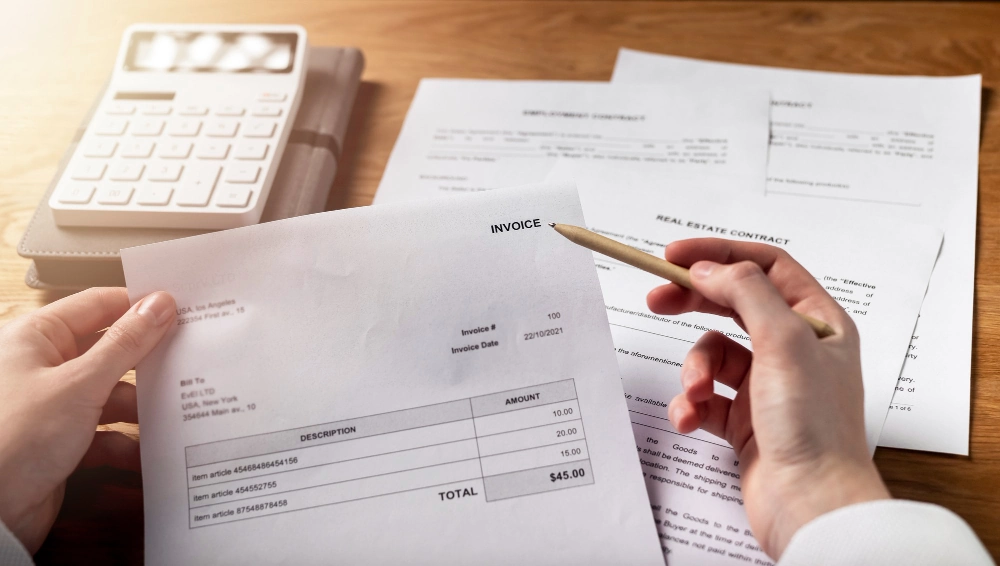
Want your business to be more organized and professional? A sales invoice is exactly what you need. This document records transactions, including the products or services provided, the amount payable, and the payment due date.
Sales invoices also make financial analysis easier. From this data, you can calculate important financial ratios such as the current ratio, debt ratio, or profit margin, making it easier to monitor your business condition.
With well-organized records, bookkeeping for small businesses becomes more structured. Read this article until the end to learn how to create a sales invoice and understand its benefits.
What Is a Sales Invoice?
A sales invoice is a billing document issued by the seller to the customer after goods or services have been delivered. This document is commonly encountered when purchasing items such as stationery or books, or when using services like laundry.
In addition to recording transactions, sales invoices also play an important role as official evidence in case of complaints or issues related to purchased products or services. Therefore, sales invoices help protect consumer rights and maintain business transparency.
Legal Basis of Sales Invoices
If you run a business in Indonesia, a sales invoice is not just an ordinary piece of paper. This document is officially regulated under the Value Added Tax (VAT) Law and also serves an important tax invoice function.
The function of a tax invoice is to provide proof of VAT collection on taxable transactions. It is also useful during tax audits, ensuring that your business remains compliant with regulations and operates safely.
Functions of a Sales Invoice
A sales invoice plays a vital role in business operations. It not only serves as proof of transaction but also supports billing, accounting records, receivables monitoring, and inventory control. Here are its main functions:
1. Legal Proof of Transaction
An invoice records every transaction, including what was sold, the quantity, and the price. This document ensures there is official proof that the seller and buyer have conducted a transaction.
2. Billing Document
Invoices help sellers collect payments from customers, especially for deferred payments. They clearly state the amount due and the payment deadline, serving as official transaction evidence.
3. Accounting Reference
Invoices serve as a key source of information for recording all transactions in bookkeeping. Data from invoices helps create clear, accurate, and easy-to-understand financial statements.
4. Monitoring Accounts Receivable
Invoices make it easier for companies to identify customers who still have outstanding payments. With this record, businesses can promptly follow up or remind customers when payments have not been received, helping maintain healthy cash flow.
5. Inventory and Stock Control
Invoices record all items purchased by customers, including quantities and types. This information helps businesses monitor inventory levels, determine when to restock, and avoid shortages or overstocking. As a result, inventory management becomes more efficient and organized.
Types of Sales Invoices
There are several types of sales invoices used based on transaction needs. Below are the most common types used in business:
1. Regular Invoice
A regular invoice is the most basic type and can be used for various transactions. It includes the invoice number, delivery date, payment due date, seller information and contact details, list of products sold, prices per item, and payment method.
2. Proforma Invoice
A proforma invoice, or preliminary invoice, is issued by the seller to the buyer before goods or services are delivered. This document is not used to request payment but to inform the buyer of the amount to be paid once the goods or services are received.
3. Recurring Invoice
A recurring invoice is created once and used to bill customers regularly without rewriting it every month. Services such as internet, telephone, or cable TV commonly use this type for regular customers. With E-Invoicing systems, invoice creation and scheduling become fast and automatic.
4. Commercial Invoice
A commercial invoice differs from everyday invoices. It is used in international trade, such as shipping machine parts from one country to another. This document provides information about the value of goods for customs purposes when crossing borders.
5. Cash Sales Invoice
A cash sales invoice is used when the buyer pays the full amount at the time of transaction. There is no payment deadline because payment has already been made. This type of invoice is ideal for retail stores or instant purchases.
6. Credit Sales Invoice
A credit sales invoice is used when customers purchase goods or services and pay later, according to agreed terms. This invoice includes the payment due date and serves as a record of the company’s accounts receivable.
Components of a Sales Invoice
A sales invoice consists of several mandatory sections to ensure transactions are recorded clearly and accurately:
-
Seller and Buyer Information: Full name, address, phone number, and tax ID (if applicable) to clearly identify both parties.
-
Product or Service Details: Description, quantity, unit price, and total price for clarity.
-
Transaction Date: The date the transaction occurred to ensure accurate bookkeeping.
-
Invoice Number: A unique, sequential number for easy tracking.
-
Total Amount Due: The total payment amount, including VAT if applicable.
-
Signature or Stamp: The seller’s signature or stamp as proof of a valid transaction.
-
Terms and Conditions: Additional information such as payment deadlines or return policies.
How to Create a Sales Invoice
A sales invoice can be created manually by writing down all essential information clearly and completely. This typically includes details of goods or services, payment amount, seller and buyer identities, and other necessary information to ensure clarity.
Invoices can also be created using simple software such as Microsoft Excel. With Excel, you can organize transaction details in tables, automatically calculate totals, and produce neat invoices without writing everything by hand.
Example of a Sales Invoice
To better understand the format of a sales invoice, here is a simple example that includes seller and buyer information, a list of goods or services, quantities, prices, total payment, transaction date, and invoice number.
The image illustrates a simple sales invoice. It displays the seller’s and buyer’s identities, invoice number and date, a list of goods or services along with quantities, unit prices, and total amounts. At the bottom, payment information is also included, such as the payment method and transfer deadline.
That concludes the explanation of sales invoices, from their definition to examples. Sales invoices are an essential part of any business. By understanding them, you can record transactions neatly, keep finances organized, and ensure timely payments and billing.
However, even with proper records, businesses may still face urgent capital needs, such as equipment repairs or unexpected operational costs. In such situations, access to fast and flexible financing can be very helpful.
BFI Finance provides solutions for these business financial needs. With collateral such as motorcycle BPKB, car BPKB, or property certificates for houses, shophouses, or office units, financing applications can be submitted with competitive interest rates.
The process is practical, secure, and transparent, supported by over 40 years of experience and supervision from the OJK (Financial Services Authority). With the right financing, transaction recording and management through sales invoices become more controlled. Your business can continue running smoothly without obstacles because #SelaluAdaJalan with BFI Finance.